
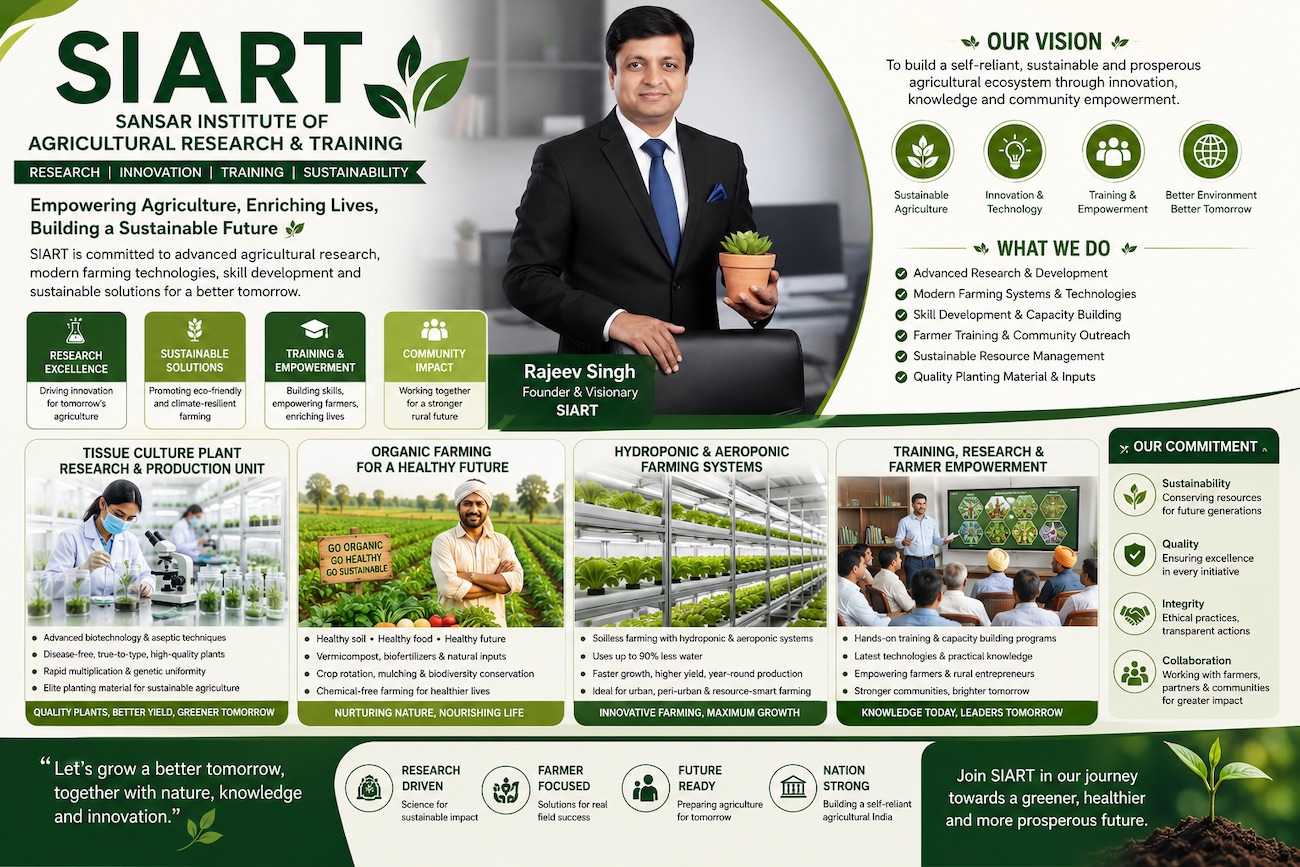
Sansar Institute of Agricultural Research & Training (SIART)
Advancing Agricultural Research, Scientific Innovation & Practical Education
प्रयोगशाला से खेत तक, ज्ञान से समृद्धि तक
About SIART
The Sansar Institute of Agricultural Research & Training (SIART) is a specialised agricultural research, innovation and capacity-building initiative within the Sansar Green ecosystem, developed under the vision of Sansar Green Mission Private Limited, a DPIIT-recognised agritech startup established in 2020.
SIART aims to strengthen the relationship between agricultural science, modern biotechnology, sustainable farming practices and practical agricultural education. Its purpose is to promote research-oriented learning, scientific experimentation, technology development and knowledge transfer that address the evolving needs of Indian agriculture.
Guided by the vision of Rajeev Singh, Founder & Managing Director of Sansar Green Mission Private Limited, SIART seeks to create a collaborative platform for researchers, agricultural scientists, students, farmers, entrepreneurs and institutional partners.
The initiative recognises that agricultural transformation requires more than technological innovation. It requires scientific understanding, practical skills, accessible knowledge, responsible resource management and continuous engagement with farming communities.
By connecting research with training and field-level applications, SIART aims to contribute to a more productive, sustainable and knowledge-driven agricultural future.
Our Vision
To develop SIART into a nationally recognised centre for agricultural research, scientific education, biotechnology, sustainable farming innovation and practical skill development.
We envision an agricultural ecosystem where scientific discoveries are translated into affordable technologies, informed farming practices, skilled human resources and improved rural livelihoods.
Our Mission
SIART’s mission is to advance agricultural knowledge and innovation through research, training, technology evaluation and institutional collaboration.
Our objectives include:
- Promoting applied agricultural research and scientific experimentation.
- Advancing agricultural microbiology, soil science and biological technologies.
- Encouraging research in plant biotechnology, tissue culture and propagation.
- Supporting sustainable agriculture and climate-resilient farming practices.
- Providing practical agricultural learning and skill-development opportunities.
- Connecting students and researchers with field-level agricultural challenges.
- Encouraging agricultural entrepreneurship and innovation.
- Facilitating research collaboration and technology transfer.
- Supporting farmers through knowledge sharing and field demonstrations.
- Developing research infrastructure and specialised training capabilities.
Core Research & Training Areas
1. Agricultural Microbiology & Microbial Biotechnology
Beneficial microorganisms play an important role in soil fertility, nutrient cycling, plant development and ecosystem stability.
SIART seeks to promote scientific understanding and applied research in agricultural microbiology, including:
- Plant growth-promoting rhizobacteria (PGPR).
- Nitrogen-fixing microorganisms.
- Phosphate-solubilising bacteria.
- Potassium-mobilising microorganisms.
- Beneficial fungal microorganisms.
- Microbial consortia and formulation research.
- Plant–microbe interactions.
- Microbial applications in soil restoration.
An important long-term objective is to support microbial strain identification, characterisation, preservation and region-specific agricultural applications.
2. Soil Science & Advanced Soil Health Research
Soil health is central to sustainable agricultural productivity.
SIART aims to strengthen scientific learning and research related to soil fertility, biological activity, nutrient management and degraded-soil rehabilitation.
Areas of interest include soil pH, electrical conductivity, organic carbon, essential plant nutrients, microbial activity and soil management strategies.
The initiative also seeks to support the development of soil-testing knowledge, analytical skills and evidence-based agricultural advisory approaches.
3. Biofertiliser & Biological Input Research
SIART promotes research-oriented learning and innovation in biological agricultural inputs.
Key areas include:
- Biofertiliser microorganisms and their functions.
- Microbial formulation principles.
- Quality evaluation and microbial viability.
- Biological nutrient management.
- Bio-input application techniques.
- Product stability and storage considerations.
- Crop-specific biological input evaluation.
- Sustainable crop nutrition.
The objective is to strengthen the scientific understanding and practical evaluation of biological technologies used in agriculture.
4. Plant Biotechnology & Tissue Culture
Plant biotechnology offers significant opportunities for agricultural innovation, plant propagation and horticultural development.
SIART seeks to support research and training in:
- Fundamentals of plant tissue culture.
- Micropropagation techniques.
- Plant growth media and culture conditions.
- In-vitro multiplication and rooting.
- Plant acclimatisation and hardening.
- Plant propagation research.
- Quality planting material development.
- Biotechnology applications in horticulture.
Specialised laboratory training and research capabilities will be developed according to available infrastructure, technical expertise and applicable requirements.
5. Grafted Plants & Advanced Nursery Technologies
Modern nursery technologies can contribute to improved plant establishment, propagation efficiency and horticultural productivity.
SIART’s research and learning interests include grafting techniques, rootstock–scion compatibility, seedling production, nursery substrates, protected cultivation and plant hardening.
The initiative aims to promote practical knowledge useful to nursery entrepreneurs, horticultural professionals, students and progressive farmers.
6. Hydroponics, Aeroponics & Controlled-Environment Agriculture
SIART recognises the potential of soilless cultivation and controlled-environment technologies for specialised agricultural production.
Research and training interests include:
- Hydroponic cultivation principles.
- Nutrient solution management.
- Aeroponic plant propagation.
- Protected cultivation systems.
- Water-use efficiency.
- Crop selection and system design.
- Technical and economic feasibility.
- Small-scale demonstration models.
The objective is to encourage scientific evaluation and responsible adoption of modern cultivation technologies.
7. Natural Farming, Organic Agriculture & Sustainable Practices
SIART seeks to promote scientifically informed approaches to sustainable agricultural production.
Areas of learning and research include:
- Natural and organic farming principles.
- Soil organic matter management.
- Composting and biological decomposition.
- Integrated nutrient management.
- Biological crop protection.
- Crop diversification.
- Resource-efficient farming.
- Climate-resilient agricultural practices.
The initiative aims to help learners understand both the opportunities and practical limitations of different farming approaches.
8. Digital Agriculture & Emerging Technologies
Technology-enabled agriculture is becoming increasingly important for improving farm-level decisions.
SIART seeks to explore educational and research opportunities involving:
- Artificial intelligence in agriculture.
- Digital soil health monitoring.
- Agricultural sensors.
- Crop data collection.
- Precision nutrient management.
- Digital farm advisory systems.
- Agricultural automation.
- Data-driven field experimentation.
These areas will support future interdisciplinary research and technology-oriented training initiatives.
Agricultural Education & Skill Development
Education and capacity building are central to SIART’s long-term purpose.
The initiative seeks to make agricultural knowledge accessible to students, farmers, agricultural professionals, rural youth and aspiring entrepreneurs.
Practical Agricultural Training
Training activities may cover soil sampling, bio-input applications, composting, nursery management, plant propagation, sustainable farming and agricultural entrepreneurship.
Emphasis will be placed on practical understanding, demonstrations and problem-solving.
Workshops & Seminars
SIART aims to organise subject-specific workshops, expert interactions, technical seminars and knowledge-sharing programmes involving agricultural scientists, professionals and industry representatives.
Certificate-Oriented Learning
Proposed short-term training programmes may address specialised areas such as agricultural microbiology, soil health, biofertiliser technologies, nursery management and sustainable agriculture.
Participation certificates or course completion certificates, where offered, will be distinguished from qualifications requiring statutory academic recognition.
Student Research & Internships
SIART seeks to provide opportunities for students and early-career researchers to engage with practical agricultural challenges through guided projects, field observations, internships and research-oriented learning.
Farmer Training & Rural Capacity Building
The initiative aims to translate agricultural science into accessible knowledge through demonstrations, local-language learning materials, technical interactions and practical training.
Research Methodology & Innovation Framework
SIART encourages a systematic approach to scientific investigation and technology evaluation.
Our proposed research framework follows:
Identify the Problem → Develop a Research Question → Design the Experiment → Collect Evidence → Analyse Results → Validate Findings → Share Knowledge → Support Practical Application
Research projects should follow suitable methodologies, appropriate experimental controls, responsible documentation and relevant biosafety requirements.
The institute aims to encourage critical thinking, scientific integrity and evidence-based decision-making.
Research Infrastructure & Future Development
SIART’s long-term development plan includes strengthening specialised research and training facilities.
Priority infrastructure areas include:
- Agricultural microbiology laboratories.
- Soil testing and analytical facilities.
- Plant biotechnology and tissue culture laboratories.
- Nursery and grafting demonstration units.
- Bio-input research and training facilities.
- Experimental agricultural plots.
- Protected cultivation demonstration systems.
- Classrooms and practical training spaces.
- Digital learning and research documentation facilities.
These facilities represent development priorities and will be introduced in phases according to resources, technical readiness and applicable approvals.
Academic & Institutional Collaboration
SIART aims to build meaningful connections among agricultural universities, research institutions, scientists, industry professionals and farming communities.
The wider Sansar Green ecosystem has institutional engagements involving IIT (ISM) Dhanbad, Bihar Agricultural University at Sabour and BIT Sindri, including incubation, innovation and project-development activities.
SIART seeks to create opportunities for:
- Collaborative agricultural research.
- Joint technical workshops.
- Student training and research exposure.
- Faculty and expert interactions.
- Field experimentation and technology validation.
- Agricultural biotechnology projects.
- Knowledge exchange.
- Technology transfer and innovation development.
Specific institutional arrangements will be represented according to their documented scope and status.
Research Publications & Knowledge Sharing
Scientific communication is an important part of agricultural progress.
SIART aims to encourage the preparation and dissemination of:
- Research articles and technical papers.
- Agricultural learning resources.
- Field trial reports.
- Technical manuals.
- Training materials.
- Research summaries.
- Case studies.
- Educational publications.
Research findings will be presented with appropriate attribution, methodology and supporting evidence.
Supporting Agricultural Entrepreneurship
SIART seeks to encourage innovation-led entrepreneurship among students, farmers, rural youth and agricultural professionals.
Potential focus areas include:
- Bio-input enterprises.
- Commercial nurseries.
- Plant propagation services.
- Soil-testing services.
- Sustainable agricultural technologies.
- Agricultural advisory services.
- Protected cultivation.
- Agricultural waste valorisation.
- Research-based agritech startups.
By connecting technical learning with business understanding, SIART aims to support the development of practical and responsible agricultural enterprises.
SIART and the Sansar Green Ecosystem
SIART is a distinct research and training initiative within the broader Sansar Green ecosystem.
While Sansar Green represents the wider organisation’s activities in agricultural innovation, products, farmer services, environmental restoration, partnerships and agricultural commercialisation, SIART focuses specifically on specialised research, scientific education, practical training and knowledge development.
This structure allows SIART to maintain a clear academic and research-oriented identity while benefiting from Sansar Green’s practical agricultural experience and industry connections.
The initiative complements Sansar Green’s wider commitment to “मिट्टी से मंडी तक” — Soil to Market.
Our Future Roadmap
SIART aims to progressively strengthen its capabilities through:
- Development of specialised agricultural research and training infrastructure.
- Expansion of soil science and microbial biotechnology learning.
- Establishment of structured practical training modules.
- Development of plant biotechnology and propagation research capabilities.
- Collaborative research and field demonstration projects.
- Student internships and guided research opportunities.
- Research documentation and publication activities.
- Digital agriculture and emerging technology education.
- Agricultural entrepreneurship and technology transfer initiatives.
- Long-term institutional development in agricultural education and research.
Why SIART Matters
India’s agricultural future depends on the ability to connect scientific innovation with practical skills and local farming realities.
SIART aims to contribute to this transformation by encouraging a culture of experimentation, scientific learning, responsible innovation and continuous knowledge exchange.
Our long-term purpose is to help develop informed farmers, skilled agricultural professionals, capable researchers and innovative entrepreneurs who can contribute to sustainable agricultural development.
Join SIART’s Research & Learning Initiatives
SIART welcomes expressions of interest from agricultural scientists, researchers, students, universities, technical experts, farmers, entrepreneurs and organisations interested in agricultural research and capacity building.
We invite collaboration proposals, training enquiries, research ideas and opportunities for technical knowledge exchange.
SIART – Researching Today. Training Tomorrow. Transforming Agriculture for the Future.
Explore Research Opportunities | Training Enquiry | Academic Collaboration | Contact Sansar Green